Tuesday, 9 August 2022
That's Food and Drink: Hitachi Aims to Reduce Food Waste with Innovative ...
That's Food and Drink: Hitachi Aims to Reduce Food Waste with Innovative ...: Hitachi's new Vacuum Compartment technology significantly extends the storage life of fresh food in your refrigerator, thus reducing foo...

That's Food and Drink: Blanco Niño Lead the Way With Recyclable Tortilla ...
That's Food and Drink: Blanco Niño Lead the Way With Recyclable Tortilla ...: If you are like my wife and I, you will feel guilty that whilst you enjoy eating tasty snacks that the packets say "not currently recyc...
Thursday, 21 July 2022
That's Food and Drink: Greener, kinder packaging for Fudge Kitchen
That's Food and Drink: Greener, kinder packaging for Fudge Kitchen: Fudge Kitchen are an artisan confectionery producer which is putting sustainability at the forefront of its business, with the launch of a n...
Thursday, 31 March 2022
That's Food and Drink: Supermarkets stop selling disposable BBQs. Expert ...
That's Food and Drink: Supermarkets stop selling disposable BBQs. Expert ...: With supermarket chains Waitrose and Aldi banning the sale of disposable barbecues this summer, Barbeque loving Brits are looking for altern...
That's Food and Drink: Over three quarters of British businesses still un...
That's Food and Drink: Over three quarters of British businesses still un...: This story is for mainly aimed at our friends in the food and drink industry. With mere hours to go until its implementation, waste managem...
Friday, 18 February 2022
That's Food and Drink: Journey's End Vineyards Launches Sustainable Spekb...
That's Food and Drink: Journey's End Vineyards Launches Sustainable Spekb...: The award-winning Journey's End Vineyards, which is based in Stellenbosch, South Africa, is pleased to announce the launch of its Spekb...
Wednesday, 12 January 2022
New sustainable bus stop displays deliver real time passenger information at any location
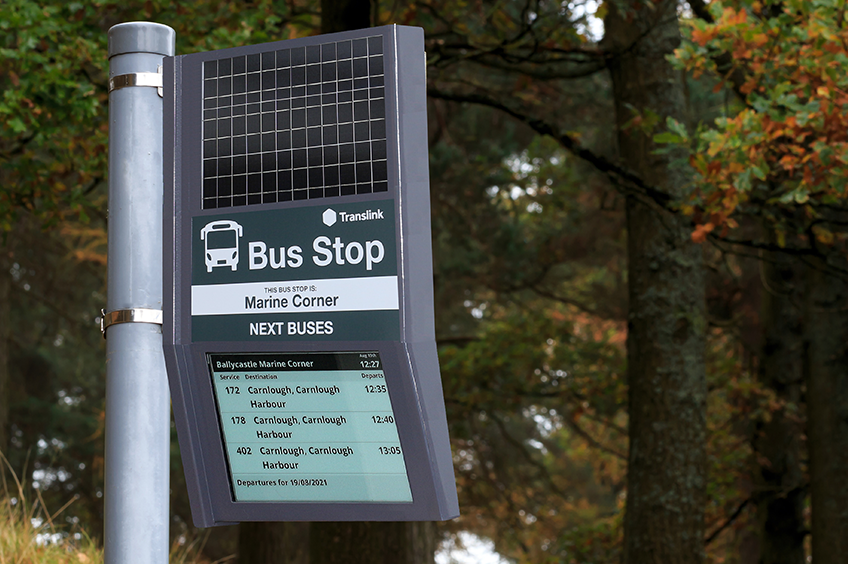
The signs are powered by batteries, or a combination of batteries and solar cells. They can operate for between three to seven years, depending on the model, before any maintenance is necessary.
The ultra-low-power displays will give passengers detailed journey information, showing both real time and scheduled data alongside emergency messages. In order to keep power consumption to an absolute minimum they employ revolutionary e-paper technology. Unlike LCD or LED signs, the new signs don't use power all the time, just when information is updated.
The new displays are also much greener in their construction. Plus when it reaches the end of its working life, the solar-powered model is almost entirely recyclable.
They can be quickly installed on any existing pole, so they're a great way to deliver real time
passenger information in rural or underserved areas at minimum cost and high sustainability.
The signs connect seamlessly to 21st Century’s EPI content management system, the RTPI and
CMS solution of choice for many of UK’s top local transport authorities.
Russ Singleton, who is the CEO of Journeo plc, said: “There is a genuine, strong demand
for transport networks to ensure all communities access real time passenger information, no matter what their location might be.
"In fact, the National Bus Strategy for England identifies the provision of bus stop information as key to giving passengers and potential bus users the confidence to choose to use public transport repeatedly.”
He went on to say: “Of course, we're very proud of these new displays, as they provide local transport authorities a means to offer accurate travel information whilst at the same time reducing their environmental impact. There isn’t anything else available to local transport authorities that provides these levels of flexibility and also sustainability, and we see a great future for these solutions.”
Subscribe to:
Posts (Atom)